
We measured the gap between the first and last day every video ad in our index was seen serving, across tens of thousands of ads. The average YouTube ad runs 74 days. The median runs 15.
Now the gap between the average and the median is what you want to understand. Most ads are switched off quite shortly after launch, but a small number runs for a very long time and drags the average up behind it.
The data
| How long the ad ran | Share of ads |
|---|---|
| 1 to 7 days | 32% |
| 8 to 30 days | 31% |
| 31 to 90 days | 16% |
| 91 to 180 days | 10% |
| More than 180 days | 11% |
Nearly two thirds of ads are gone inside a month. One in five is still serving after three months.
Why is the average so much higher than the median?
Because run length tracks performance almost perfectly. Ads that survive their first month are ads that cleared someone's CPA target, and once that happens there is no reason to turn them off.
The numbers line up cleanly:
- Ads in the top tenth by views run an average of 111 days, half again as long as the overall average.
- Ads that get duplicated into ten or more campaigns run an average of 82 days.
- Ads killed inside a week average a fraction of the views of ads that reach the one-to-three-month band.
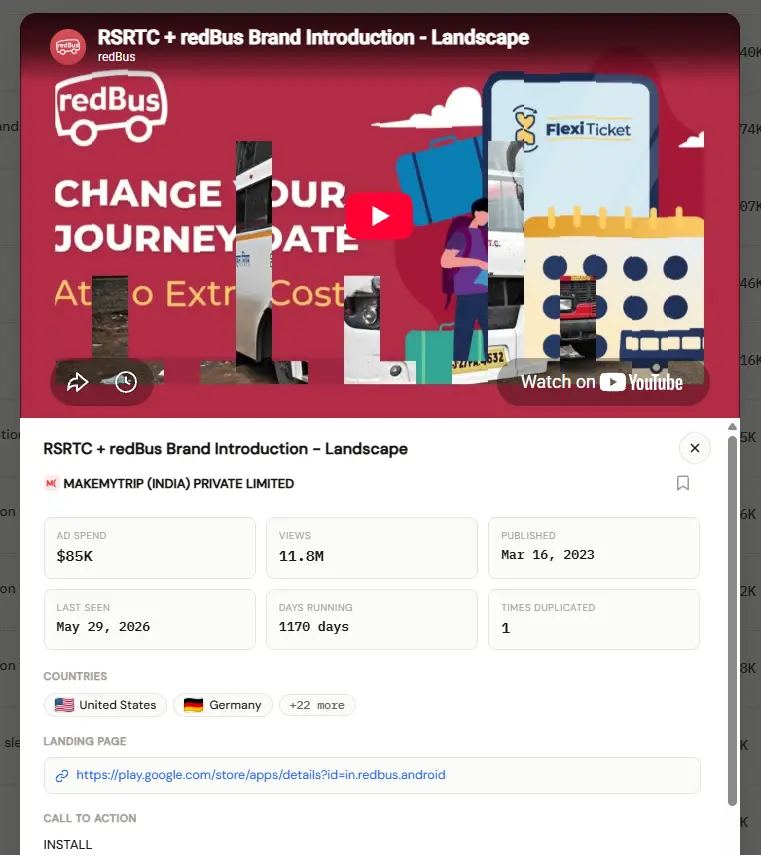
The longest runs in the index are extreme. MakeMyTrip, the travel booking brand, has app-install creatives that stayed in market for over 1,170 consecutive days, three years of the same video, still collecting views. Nobody keeps paying that long for an ad that is not converting.
Run length is a performance signal you can read from the outside
You cannot see a competitor's CPA (unfortunately). But you can see how long they were willing to pay for a given creative, and that's one of the closest public proxies you have.
We can't learn a lot from a newly launched ad. But if you see an ad that's been live for 200 days, it tells you there is probably a reason media buyer didn't turn it off early. Of course, in rare cases, it's a brand awareness campaign, or a media buyer mistake (oops).
The same rule applies to duplication count. An ad that is both long-running and duplicated across campaigns is about as strong a signal as the outside world gets. It is also why one ad tends to carry 36% of a brand's entire YouTube reach: the winner keeps running while everything around it is retired inside two weeks.
What this means for your own testing
Judge your account by how many ads survive 90 days, not by how many you launched.
- Expect most tests to die fast. A 15-day median is not failure, it is the normal shape of creative testing. Budget for volume: the top 1% of advertisers run a median of 109 distinct ads each.
- Give a test enough runway to clear noise, then cut it decisively. The ads that end up mattering usually show signal early.
- Do not retire a winner on a schedule. Retire it when performance decays. Frequency fatigue is real, but it arrives far later than most teams assume.
- When you study competitors, sort by days running before you sort by anything else. The ecommerce ad examples worth copying are almost always the long runners, not the newest uploads.
How to check run length on any advertiser
Open an advertiser in VidSniff and every creative shows its first and last seen dates, days running, duplicate count, estimated spend and target countries. Sorting by days running surfaces the proven formulas immediately, and skips the long tail of tests that never made it past week one.
How we calculated this
We work from publicly observable signals on video ads: the dates a creative was seen serving, view counts, and how often the same creative reappears across campaigns and countries. Run length is the span between the first and last observed serving date for each distinct creative, counted inclusively, and we only included ads where both dates are known. Ads still live at the time of measurement are counted up to their most recent sighting, which makes these figures conservative rather than inflated. Spend figures elsewhere in our index are directional estimates derived from delivered views, not reported budgets.