

The short answer: YouTube CPMs average $9 to $12 across most niches for standard in-stream ads, with Shorts CPCs around $0.81 and skippable in-stream CPCs around $1.01. But those numbers are just the starting point. What you actually pay depends heavily on your niche, your format, and more than anything else, the quality of your creative.
I have spent over $10M on YouTube ads over the past year. It has become one of the best prospecting and demand generation channels available, comparable to what Meta was a few years ago. Below I am sharing industry benchmarks, real cost data from four of my own ad accounts, and what actually moves the numbers.
YouTube ad cost benchmarks at a glance (2026)
Average YouTube ad costs by format
| Format | Avg CPM | Avg CPV | Avg CPC |
|---|---|---|---|
| Skippable in-stream | $9.29 | $0.024 | $1.01 |
| Non-skippable in-stream | $11 to $15 | N/A | N/A |
| YouTube Shorts ads | $4.85 | $0.10 to $0.30 | $0.81 |
| Connected TV (CTV) | $16.20 | $0.038 | N/A |
| In-feed / Discovery | $6 to $10 | $0.02 to $0.03 | $0.49 |
Sources: Adzoola ($14.3B in spend), DigitalApplied Q1 2026, Store Growers.
How YouTube compares to other platforms
| Platform | Avg CPM | Avg CPC |
|---|---|---|
| YouTube (in-stream) | $9 to $12 | $0.81 to $1.01 |
| Meta (Facebook) | $11 to $15 | $0.62 to $0.94 |
| Meta (Instagram) | $12 to $19 | $1.17 to $1.31 |
| TikTok | $6 to $10 | $0.50 to $1.00 |
| Google Search | $38 to $45 | $2.50 to $4.50 |
| Google Display | $3 to $5 | $0.44 |
YouTube typically comes in below Meta on CPM, which surprises most advertisers who assume it is expensive. Google Search is in a completely different cost category because you are capturing existing demand rather than creating it.
Is YouTube getting more expensive?
Yes. And it is worth understanding why.
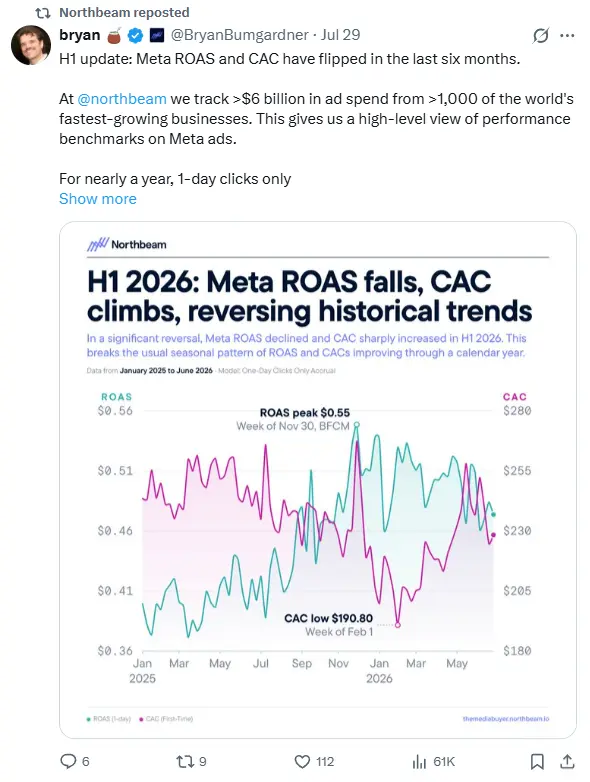
Recently I came across a post from Bryan Bumgardner at Northbeam, who tracks over $6 billion in ad spend from more than 1,000 fast-growing businesses. Their H1 2026 data showed something worth paying attention to: Meta ROAS fell and CAC climbed for the first time in years, reversing the historical seasonal pattern.
That is a Meta-specific data point, but the dynamic is familiar on YouTube too. More advertisers have discovered that YouTube works for direct response and demand generation, not just brand awareness. CPV inflation across YouTube ran at 7% year over year in Q1 2026, and CTV inventory is up 18% year over year. A $10,000 monthly YouTube budget today buys roughly 6.5% fewer views than it did 12 months ago.
YouTube advertising is not getting cheaper. But unlike Meta, where rising costs are largely driven by auction competition you cannot control, on YouTube your creative quality has a direct and measurable effect on what you pay. More on that below.
Real account data: what I am actually paying across 4 products
Here are the average CPC and CPM from four active ad accounts over the last 90 days.
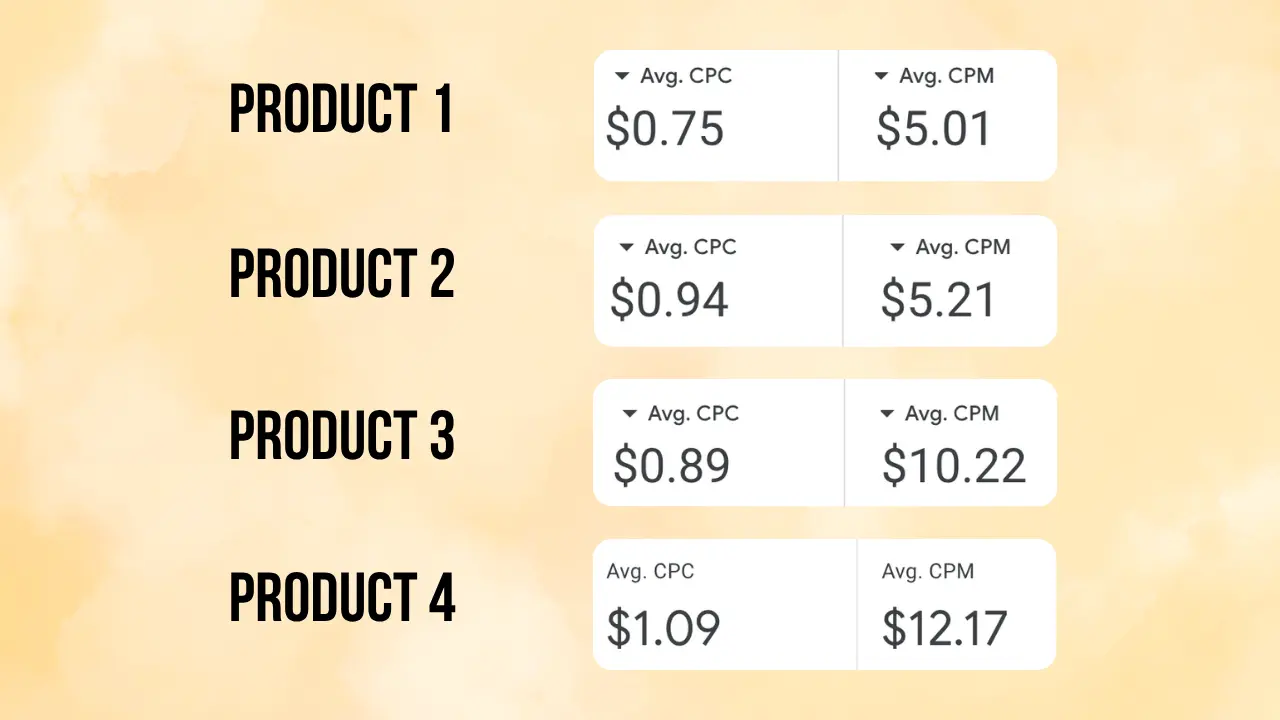
A few things worth noting when you look at these numbers.
Products 1 and 2 are in a less competitive niche and running broad prospecting audiences, which gives the algorithm more inventory to work with and keeps CPMs in the $5 range. Products 3 and 4 are in higher-competition categories where audience value is higher, which pushes CPMs to $10 to $12. That is still within the benchmarks, but meaningfully different from the lower two accounts.
The CPC range ($0.75 to $1.09) is tighter than the CPM range, which is typical. CPM reflects the cost to reach an audience. CPC reflects the combination of that cost and how well the creative drives clicks. A higher CPM does not necessarily mean a higher CPC if the creative is strong enough to generate above-average CTR.
These are also 90-day averages. Within those 90 days, the costs are not flat. New creatives start expensive and come down as the algorithm learns. Which brings me to the most important thing I have learned about YouTube ad costs.
The biggest lever nobody talks about: creative quality
Here is something I have seen consistently across millions in YouTube ad spend.
A new campaign almost always starts expensive. CPM and CPC are elevated in the first days while the algorithm figures out who responds, who skips, and who clicks. This is expected and normal.
What is not normal is staying expensive.
When a creative is actually winning, the algorithm identifies it and costs start dropping. I have watched CPMs fall 40 to 50 percent between the first week of a campaign and week four or five, with zero changes to targeting or budget. The algorithm finds increasingly efficient inventory because it has clear signal on who engages.
The chart below from one of my accounts shows this pattern.
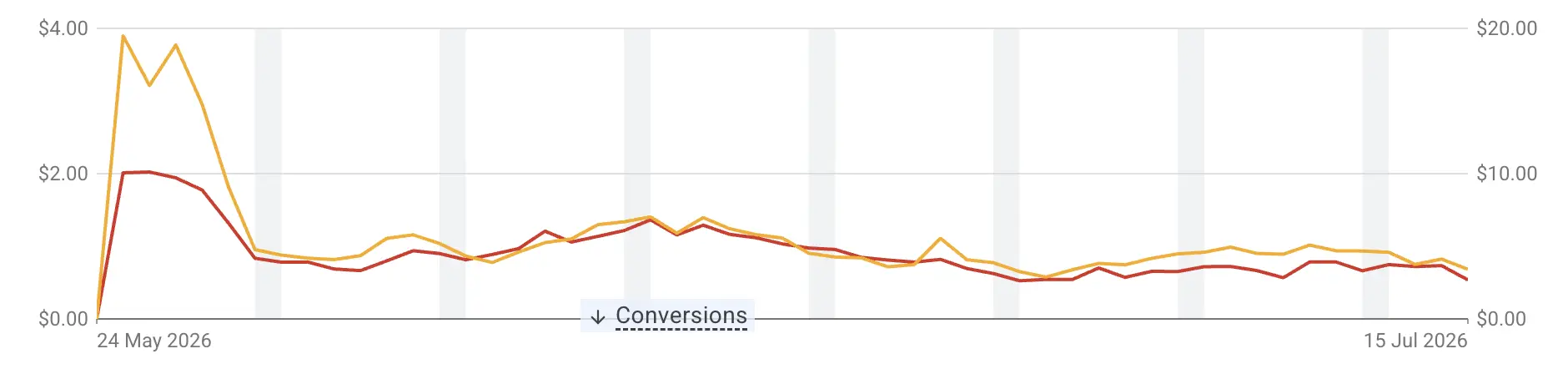
When a winning ad started finding its audience, both CPM and CPC declined steadily over time. The creative did not change. The targeting did not change. The algorithm just got better at finding the right people, and the cost reflected that.
The opposite is equally consistent. A creative that never generates strong engagement signal stays expensive indefinitely. The algorithm keeps randomizing to find someone who responds, it never does, and you keep paying a high CPM for low-quality traffic.
What this means practically: the single most effective thing you can do to reduce your YouTube ad costs is find a winning creative faster.
Most experienced YouTube advertisers run three to five creative variations per concept and let the platform identify the winner. The difference between the best and worst creative in a test is rarely small. A winning ad can outperform a losing one by a factor of two or three on CPC, with CPM following as the algorithm scales the winner.
Testing more creatives is not just a performance strategy. It is a cost reduction strategy.
What else affects YouTube ad costs
Niche competition. Finance, legal, and B2B SaaS categories pay the highest CPMs because the audience value justifies higher bids from competitors. Ecommerce and retail tend to come in cheaper. Your floor CPM is partly determined by who else is bidding on your audience.
Campaign objective. Awareness campaigns have lower CPMs. Conversion-optimized campaigns are more expensive per impression because Google is finding people likely to take an action, not just view. The higher CPM is expected and usually justified by the quality of the traffic.
Ad format. Skippable in-stream ads are the default for performance marketing and sit around $9 CPM on average. YouTube Shorts ads come in at roughly $4.85 CPM, nearly half the price, but require vertical creative and a completely different hook structure. CTV runs at $16.20 CPM and drives high completion rates but almost no direct purchases.
Geography. US audiences are the most expensive. UK, Canada, and Australia follow. Mixing countries in one campaign blends your cost data and reduces optimization clarity. Separate campaigns by geography if you are running international traffic at meaningful scale.
Device targeting. Mobile CPV averages $0.022. Desktop runs $0.029. CTV reaches $0.038. For conversion campaigns, excluding Connected TV and tablets often improves efficiency because those devices drive views but rarely drive purchases.
Seasonality. Q4 is the most expensive time to advertise on YouTube. More brands compete for holiday attention and CPMs rise across the board. Q1 tends to be the cheapest entry point. A 7% cost increase means a $10,000 budget in Q4 2026 will buy meaningfully fewer views than the same budget in Q1.
Budget. Counterintuitively, larger budgets tend to result in lower CPMs over time because Google has more spend data to optimize against. Campaigns running on under $100 per day often stay in an inefficient learning phase longer than they should.
How to reduce your YouTube ad costs
Test more creatives, faster. The creative is the biggest cost variable you can control. Run three to five hook variations per concept. Let the platform pick the winner. Then scale the winner and retire the losers.
Match format to objective. A 60-second talking-head ad for an awareness campaign is the wrong tool. A 6-second bumper for a conversion goal wastes the format. Format and objective alignment reduces wasted impressions.
Separate campaigns by geography and device. Blended targeting makes cost data harder to read and harder to optimize. Separate US from international, and consider excluding CTV from conversion campaigns.
Let winners run without interference. When the algorithm finds a winning creative, resist the urge to make targeting changes in the first week. The learning phase needs clean data to find the right inventory.
Study what is working in your niche before you start testing. If you are building a creative brief without looking at what is actually scaling in your category, you are starting with a disadvantage. The creative patterns that work, the hook types, the formats, the offer structures, all leave signals in the data if you know where to look. Browsing real YouTube ad examples is the fastest way to see those patterns.
Ready to launch YouTube ads?
If you are serious about YouTube advertising, understanding costs is only part of the equation. The real advantage goes to advertisers who know what creative is working in their niche before they spend their first dollar on testing.
That is exactly what VidSniff is built for. It indexes hundreds of thousands of YouTube ads with estimated spend, view counts, longevity signals, and duplicate detection. You can search by competitor domain, keyword, or niche, and filter by performance tier to see what is actually being scaled right now, not just what was uploaded.
Most teams waste their first three to six months on YouTube testing creative structures that have already been proven not to work in their category. With VidSniff you can skip that phase entirely and start your tests from a foundation of what is already winning.
Start a free 3-day trial. No credit card required for the first three days.